
In the footsteps of St. Francis of Assisi: La Verna sanctuary, Hermitage of Cerbaiolo and of Montecasale
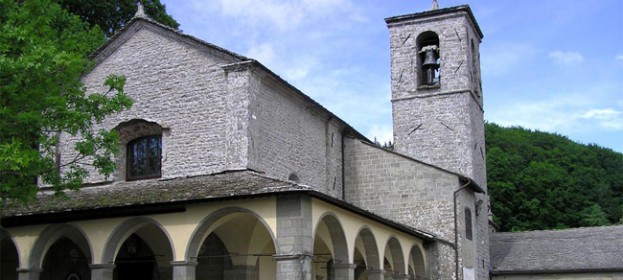
The Valtiberina paths were also the paths of Francis of Assisi, who trails them many times to get to La Verna, the most important Franciscan monastery after the Assisi’s one. For its own initiative or in his memory convents, monasteries and hermitages scattered in this corner of Tuscany have arisen, and they still welcome pilgrims and people from all over the world in search of spirituality.
Sanctuary and monastery of La Verna (30 minutes away from the Il Sasso)
The site on which the sanctuary and the monastery of La Verna stand (1128 meters above sea level) was given in 1213 to Francis by the Count of Chiusi in Casentino. Ideal for meditation, it was lived by Francis for long periods of the year and here he received the stigmata in September of 1224. A visit to La Verna is exciting from spiritual, naturalistic and artistic points of view. The Church of St. Maria degli Angeli is the most ancient manufact built in La Verna, dating back to 1216-17 and it contains polychrome terracotta by Andrea della Robbia. The Basilica of Santa Maria Assunta, built between 1348 and 1509, contains other Andrea Della Robbia’s terracottas and a monumental organ of rare quality dated 16th century. Sasso Spicco is a giant fissure in the rock in which the Holy stood in prayer, and the bed of S. Francis and the passage of the Stigmata, built in 1578 and recently painted. The Chapel of the Stigmata, dating from the thirteenth century, is the most sacred place of the Mount. The St. Anthony’s cave is just next to the Chapel. The forest monumental climbs on Mount Penna and the view you can enjoy from the “dial”, the square in front of the Basilica, are really amazing.
On September 30th, 1224, after receiving the stigmata on Mount La Verna and during his last trip to the town, Francis stopped at a place called La Casella (m. 1,263 m asl) in the municipality of Caprese Michelangelo, to fulfill a ritual. Aware of the now near end, he wanted to say goodbye for the last time to Mount La Verna, visible from that place. His words are as below: “Good-bye, mountain of God, holy mountain, mons coagulatus, mons pinguis, mons in quo beneplacitum est Deo habitare! Farewell Mount Alvernia; God the Father, God the Son, God the Holy Spirit bless you! Rest in peace, che più non ci vedremo. Farewell Mount Alvernia; Remained in peace, we will never see again”. The hermitage, which is currently unhabited, is composed of a chapel and an always open shelter.
Hermitage “delle Caselle” (30 minutes away from the Il Sasso)
Castle and Sanctuary of Montauto (20 minutes away from the Il Sasso) and Anghiari
From there, Francis reached the Castle of Montauto, where it is said he was used to stop as a guest of Prince Alberto Barbolani, to which he gave his old cassock in exchange for a new one. Now the old cassock can be seen in a chapel of La Verna Sanctuary. The Holy Man, to meet the people, went to the highest point of the village of Anghiari, where three roads met and it is said that he planted there a cross. The popular demand to erect a chapel and then a monastery rise from this visit. from then on the monastery grew over the centuries, until it became a real village, called “Borgo della Croce.” Alberto also promised Francis to build a monastery in Montauto. The promise was kept only much later by his heirs.
Hermitage of Cerbaiolo (30 minutes away from Il Sasso)
Cerbaiolo ( 861 m asl), a small hermitage built on the rock, is located in the town of Pieve Santo Stefano. In the Tiber Valley there is a saying: “Whoever has seen La Verna and not Cerbaiolo, have seen the mother but not the son”. Its origins date back to the eighth century when, in the year 722, Tedaldo, Lord of Tiferno (now Citta di Castello) donated the church and the monastery to the Benedictine monks of San Michele Arcangelo al Presale. In 1218 the Franciscans took up residence there. It’s not sure that Francis lived there, but it is likely that he passed there during his travels. It’s certain, however, that St. Anthony of Padua rested there. The hermitage was destroyed by the Germans in 1944 and restored also by the work of Clare, a laborious hermit of the Little Company of St. Elizabeth. She lived there alone until his death in 2010. Currently the hermitage is run by Brother Francis that offers hospitality to those who want to spend a few days closeer to God.
Hermitage of Montecasale (20 minutes away from Il Sasso)
The hermitage of Montecasale (d. 706 above sea level) is on one of the hills above Sansepolcro. It was built in the twelfth century on the ruins of an ancient fortress by the Camaldolese monks, who used it as a hospice for pilgrims and as a service center for the sicks. Later it was sold to the Franciscan monks by the Bishop of Città di Castello. Tied to this place are the episodes of the three thieves and the planting of cabbage in the garden. The first, reported in the “Fioretti”, says that three thieves which raged in the area with their misdeeds, came to the Hermitage asking for food. They were driven away in a bad way by the monk guardian. Francis, returned from begging bringing bread and wine, heard what had happened and blame the guardian, ordering him to look for the robbers in the woods and bring them bread and wine, and ask them for forgiveness his cruelty. After the departure of the friar, Francis prayed that their hearts soften and repent. The event went well beyond expectations, because the robbers returned to the Hermitage, converted, even requesting to join the Order and they died in Montecasale, where their mortal remains are still preserved. The incident related to the garden said that Francis, wanting to test the spirit of Obedience of two young men went up to the monastery to join the Order, took them in the garden and told them to plant cabbages as well as he did. Francesco planted them upside down and, while one of the young people did as he had said, the other continued to refuse. Only one of them, therefore, he was accepted into the Order. Even today cabbages are grown in the garden of Montecasale are grown in the garden of cabbages. The visit to the small cloister, Sasso Spicco, is very amazing. It is a place where it is said Francis competed with a nightingale singing in praise of the Lord and of the bed of St. Francis. The oldest and most valuable artwork exhibited in the church is the sculpture of the Madonna and the Child, of the thirteenth century.
In the small and intimate chorus there are small ceramic squares of 1600 depicting episodes of the life of St. Francis and facts about Montecasale and a painting of the 1500 depicting St. Francis drinking from the side of Christ. In the corridor that connects the church to the cloister, there is the Chapel of the Crucifix. A Crucifix, dated 1400, is placed on the altar of the Chapel is placed. The remains of the converted thieves and the cassock of the Blessed Ranieri of the Mountain are preserved in the reliquary.
It is also possible to continue the journey of St. Francis at Assisi. The city is about 75 km away (50 minutes car ride).

